Gemini 3.7 Flash in Timeln: a second brain that thinks only as hard as it needs to
Google shipped Gemini 3.7 Flash on 13 August. We migrated Timeln within two days, then audited what the model was actually thinking about. The result: 85% cheaper, 67% faster, on the same prompts and the same outputs.

Rahul Kumar
Founder, Timeln
Published: 15 August 2026 · Reading time: ~9 min · Category: Engineering
Google shipped Gemini 3.7 Flash on 13 August. Timeln has been running on it since 15 August.
The upgrade itself took an afternoon. The interesting part was what we found while doing it: most of what we were paying an LLM for was thinking we never saw, on jobs that did not need thinking at all. Fixing that made your second brain 85% cheaper to run and 67% faster, on the same prompts, producing the same outputs.
Here is the whole story, with the measurements.
A second brain is an agentic system, not a filing cabinet
When you save something to Timeln, you are not dropping a file into a folder. You are kicking off a chain of small jobs:
- the document gets read, chunked and embedded
- entities and relationships get extracted into your knowledge graph
- it gets classified into projects, areas, resources or archive
- it gets folded into your weekly and monthly summaries
- it gets checked against everything else you have saved for non-obvious connections
Every one of those is a model call. Ask a question and another chain fires: expand the query, search the graph, search your documents, rerank, synthesise. A single "what do I know about pricing?" can be a dozen calls deep.
This is why a second brain lives or dies on agentic performance. Not on how eloquent the model is, but on whether it can run a multi-step chain of tool calls without falling over, and whether it can do it fast enough and cheap enough that we can afford to run it on every single thing you save.
That is exactly the axis Gemini 3.7 Flash moved.
What actually improved
The gains that matter for us are not the essay-writing ones. They are the agentic and long-context ones.
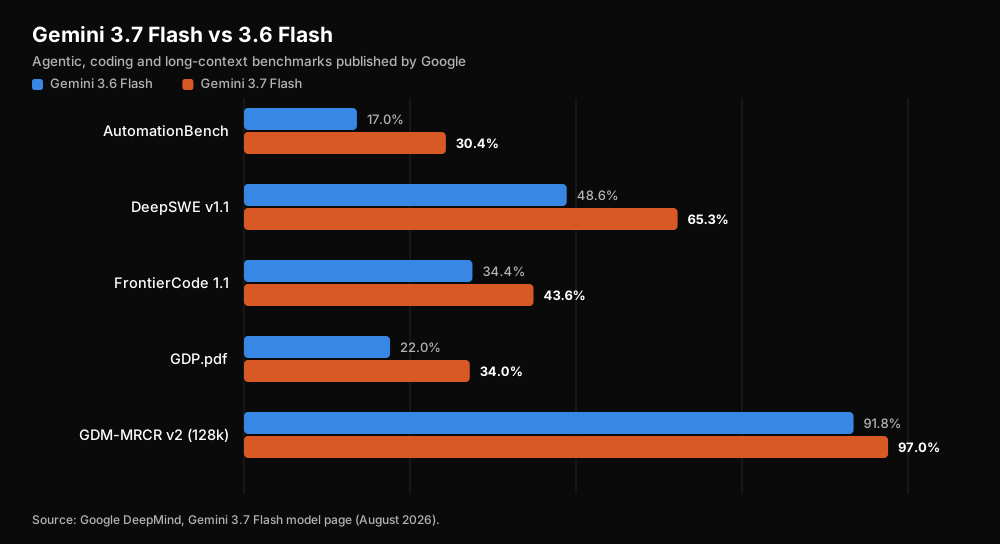
AutomationBench went from 17.0% to 30.4%. That is Google's private set for enterprise workflow automation, and it nearly doubled. It is the closest public proxy for "can this model drive a multi-step job to completion without human help", which is the thing an ingestion pipeline does thousands of times a day.
DeepSWE v1.1 went from 48.6% to 65.3% on long-horizon software engineering, and GDM-MRCR v2 at 128k context went from 91.8% to 97.0%. That second number is quietly the most important one on the chart for us. Timeln stuffs a lot of retrieved context into a prompt before asking for an answer. A model that loses the thread at long context produces answers that are confidently missing the one document that mattered.
And the price went the other way. Gemini 3.5 Flash, which we were on, costs $1.50 per million input tokens and $9.00 per million output. Gemini 3.7 Flash launched at $0.75 input and $3.75 output — introductory pricing that holds through 31 December 2026, then rises to $1.50 and $7.50.
So: better at the agentic work, better at long context, cheaper per token. Easy call.
But the model swap turned out to be the smaller half of the win.
The dial nobody touches
Gemini 3 models let you set how hard the model thinks before it answers. It is one parameter, thinking_level, and on 3.7 Flash it takes three values: low, medium and high. Medium is the default.
Default means every call we made was thinking at medium. Including the ones that had no business thinking at all.
Our P.A.R.A. classifier is the clearest case. Its entire job is to look at a saved item and pick one of four labels: project, area, resource, or archive. It does not need to reason. It needs to recognise. And it was burning 1,266 thinking tokens per call to do it — reasoning you never see, on a task with four possible answers.
Thinking tokens bill as output tokens. Output tokens are the expensive ones. So we were paying premium rates for a model to deliberate over which folder a bookmark belongs in.
We went through every model call in Timeln and set the level by hand, based on what the job actually is:
// Bucketing items into four fixed categories — classification, not reasoning.
const result = await ai.models.generateContent({
  model: 'gemini-3.7-flash',
  contents: prompt,
  config: {
    thinkingConfig: { thinkingLevel: ThinkingLevel.LOW },
  },
})
Extraction, classification and summarisation of already-structured data went to low. Genuine synthesis stayed at medium. Nothing went to high.
What that did
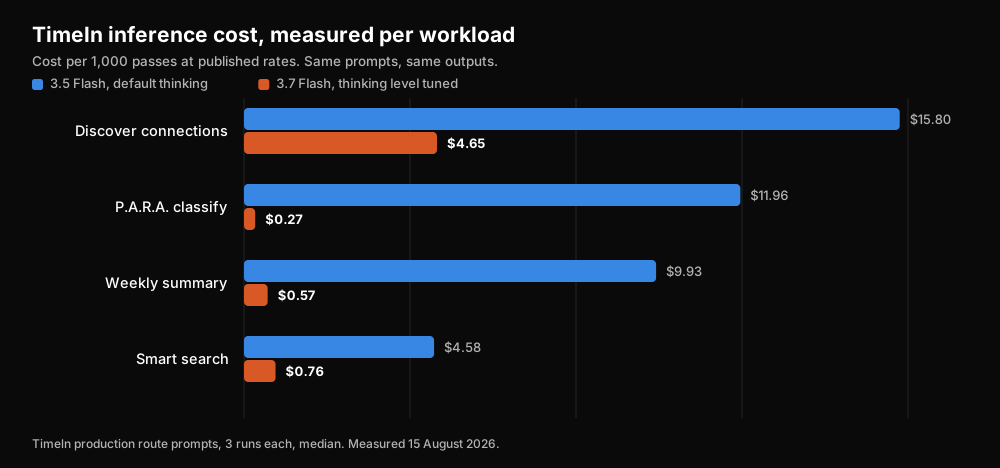
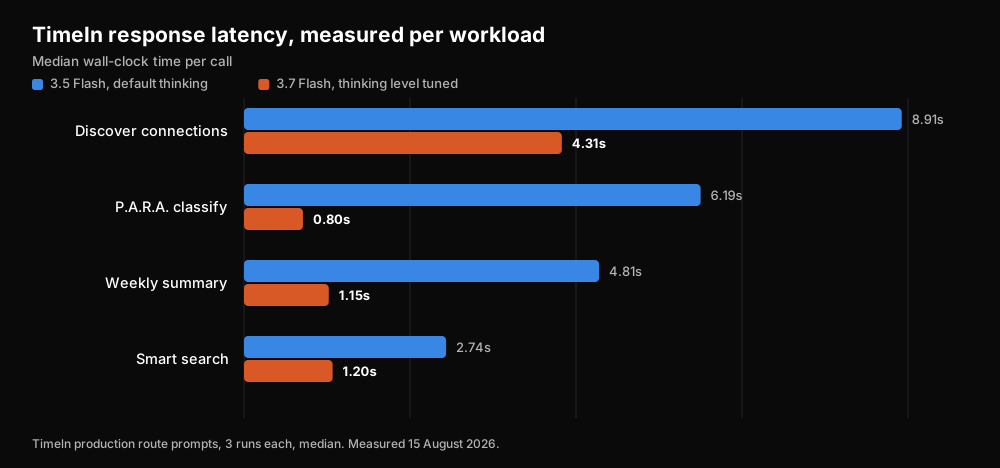
We benchmarked it properly rather than guessing: the real prompts from the real routes, three runs each, median, costed at published rates.
The full numbers:
| Workload | Latency before | Latency after | Cost / 1k before | Cost / 1k after | Thinking tokens before → after |
|---|---|---|---|---|---|
| Smart search | 2.74s | 1.20s | $4.58 | $0.76 | 321 → 0 |
| P.A.R.A. classify | 6.19s | 0.80s | $11.96 | $0.27 | 1,266 → 0 |
| Weekly summary | 4.81s | 1.15s | $9.93 | $0.57 | 945 → 0 |
| Discover connections | 8.91s | 4.31s | $15.80 | $4.65 | 1,438 → 854 |
| Full pass | 22.66s | 7.46s | $42.27 | $6.24 | — |
Across a full pass over a saved document: 85% cheaper and 67% faster. The classifier alone went from 6.19 seconds to 0.80 — it stopped deliberating and started answering.
Same prompts. Same outputs. We just stopped paying the model to think about things that do not need thinking.
The job we left alone
One workload kept its reasoning budget: discover connections, the one that looks across everything you have saved and proposes links you had not noticed.
It still burns 854 thinking tokens per call. It is still the slowest thing we run, at 4.31 seconds. We left it at medium on purpose.
That is the actual lesson, and it is the opposite of "turn everything down". Finding a non-obvious relationship between a paper you read in March and a meeting note from last week is genuinely hard. It is the one job in the pipeline where the reasoning is the product. Starving it to save a fraction of a cent would make Timeln worse at the exact thing it exists to do.
The win was never "think less". It was think proportionally — spend reasoning where it changes the answer, and stop spending it where it does not.
What this means if you use Timeln
Nothing to update, nothing to configure. It is already live.
- Search comes back faster. Query expansion dropped from 2.74s to 1.20s, and that sits at the front of every search you run.
- Saves settle sooner. Classification and summarisation are near-instant now, so a new document shows up organised instead of pending.
- The expensive thinking goes where you can feel it. Connection discovery still gets a full reasoning budget, and it is better at long context than it was last week.
- We can afford to run more of it. An 85% cost reduction is the difference between running deep analysis on your most recent saves and running it across your whole library.
That last one matters most. Cost is not an accounting detail in a product like this — it is the constraint that decides how much thinking your second brain is allowed to do on your behalf. Lowering it raises the ceiling on what we can offer.
Two honest caveats
The benchmark is four workloads, not production traffic. These are the real prompts from the real routes, measured properly, and the per-call mechanics are solid. But your actual savings depend on your real request mix. We are reporting what we measured, not a projection.
Part of the price drop is introductory. Gemini 3.7 Flash reverts to $1.50 / $7.50 on 1 January 2027. The latency improvements and the eliminated thinking tokens are permanent and structural. A slice of that 85% is a launch promotion, and we would rather say so than have you find out in January.
The takeaway
Everyone upgrades the model. Far fewer people audit what the model is thinking about.
The model swap gave us a better agentic engine at half the token price. The thinking-level audit gave us the other 60 points of the cost reduction, and it cost nothing but the afternoon it took to read every call site and ask a simple question: does this job actually require reasoning, or does it just require an answer?
If you are running LLM calls in production, that question is probably worth an afternoon of yours too.