24 AI assistants, zero memory: knowledge management just became infrastructure
We spent twenty years selling knowledge management to humans who did not want it. Now the agents need it, and that changes everything. An annotated rundown of the 24 assistants worth knowing, and the layer none of them provide.

Rahul Kumar
Founder, Timeln
Published: 8 September 2026 · Reading time: ~9 min · Category: Industry
Every AI agent you use has amnesia.
I went through 24 of them for this piece. Claude Code, Codex, Manus, Lindy, Orchid, Instinct, ChatGPT Work, and the rest. Every one of them executes brilliantly and remembers nothing.
That is a bigger deal than it sounds, and it changes who knowledge management is actually for.
We built knowledge management for people who did not want it
Twenty years of tools. Evernote, Notion, Obsidian, Roam, and a hundred others. The pitch never changed: your brain leaks, here is a net.
Most people never really bought it. Not because the tools were bad. Because note-taking is work you do now for a payoff that arrives much later, if it arrives at all. You write the note, and future-you never opens it. The habit collapses under its own overhead, and the category stayed niche for two decades.
That changed this year. Not because people suddenly got more organised.
Because the agents need it now.
Watch how a session with an agent actually starts
You paste the context back in.
The project background. The decision you made in March, and the reason behind it. The client constraint that rules out the obvious approach. The thing you already tried that did not work, so it does not get suggested again.
Every session. By hand. You are doing manual knowledge retrieval on behalf of a machine that is otherwise faster than you at everything else in the workflow.
That is the tell. Knowledge management stopped being a productivity habit and became infrastructure.
The payoff moved
This is the part I think people are underrating.
Organising your notes used to serve future-you, who was unreliable and might never read them. The return was speculative and distant, which is exactly why the habit never stuck for most people.
Now the same activity feeds an agent that reads all of it today and does the work with it. The context you capture on Monday is doing labour on Tuesday. Same activity, completely different return.
Knowledge management was a discipline you had to be virtuous enough to maintain. It is turning into a system input with a measurable output, which is a much easier thing to justify.
Which means the assistant race gets decided on memory, not capability
Doing keeps getting cheaper. Every model release turns execution further into a commodity. The gap between the best agent and the third-best agent at booking a table, drafting a reply, or refactoring a file is closing, and it will keep closing.
Knowing you does not get cheaper.
Your decisions, your threads, the reasons behind both, the constraints you never wrote down anywhere. That does not arrive with the next model. It accumulates, or it does not.
Whoever holds that context wins. Right now nobody holds it, because it is scattered across ten apps that do not talk to each other, and the assistants themselves throw it away when the session ends.
The landscape, and where the hole is
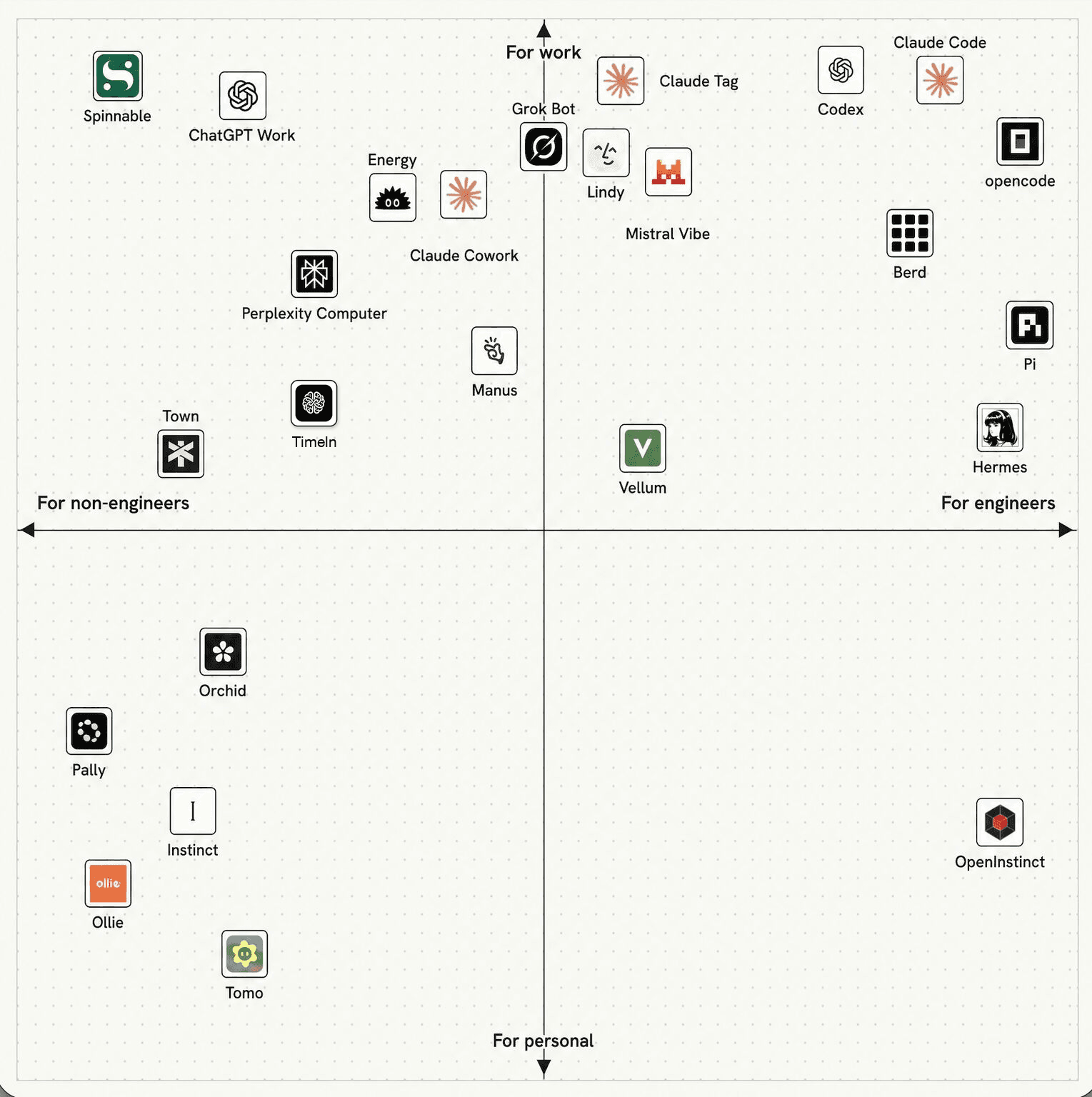
Here are the 24 assistants worth knowing about, on two axes: for work versus for personal, and for engineers versus for non-engineers. Timeln is on there too, left of centre and mid-height, and I will come back to why it sits where it does.
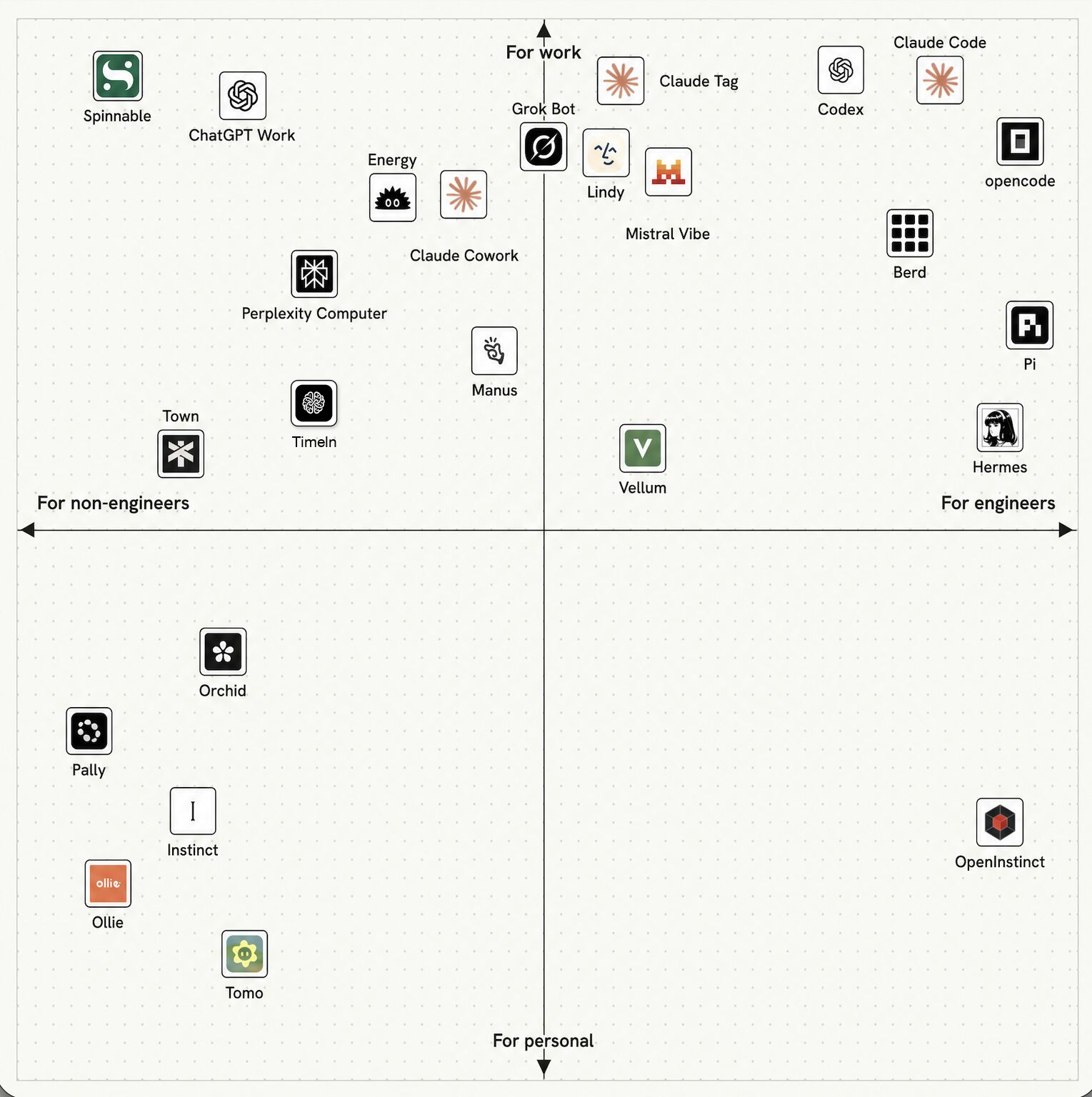
Ten products crowd the top-right, engineers and work. Seven sit top-left, non-engineers and work. Five in the bottom-left, non-engineers and personal. One in the bottom-right, engineers and personal. Grok Bot sits on the vertical axis, refusing to pick a side.
Look at the top-left before reading the rundown. Several products converging on the same pitch, an agent for people who do not write code, with no clear line between any of them. The usual read is that the category is young. I do not think that is it. They all restart from zero every session, so none of them accumulates the one asset that would separate it from the next one.
You cannot own a category built on amnesia. If the product forgets, every session is a first session, and switching costs nothing.
Top-right: engineers, work (10)
Claude Code (Anthropic) — agentic coding in the terminal, plus IDE extensions and a web surface. Reads and edits your codebase, runs commands, completes multi-step engineering work. In every paid Claude plan. claude.com/product/claude-code
Codex (OpenAI) — the software-engineering agent, as CLI, IDE extension, web app and iOS app, with cloud background agents you can delegate to. Moved from message-based to token-based credit pricing in 2026.
opencode — open-source terminal coding agent, MIT licensed, connecting to a long list of model providers including local ones. Built by the SST team, reportedly now operating as Anomaly. Watch the name: several unrelated repos share it, including an earlier, different opencode-ai/opencode. The one you want is opencode.ai.
Mistral Vibe (Mistral AI) — chat assistant plus terminal-native coding agent, connecting to MCP servers and running parallel and remote agents. Vibe 2.0 went generally available at the end of January 2026. Mistral's product page calls it "formerly Le Chat," so this is a rebrand, not a new product, though sources disagree on whether it replaces Le Chat or is bundled with it. mistral.ai/products/vibe
Berd (Block, Inc.) — Jack Dorsey's company open-sourced this in August 2026. A local-first desktop workspace giving multiple agents a home: roles, skills, tools, projects, session history, visual identities. Built on Goose, Apache 2.0, free. The site doesn't mention Block anywhere. berd.xyz
Hermes (Nous Research) — released February 2026. Open-source self-improving personal agent with three-layer memory: skill memory, conversational memory, and a user model that persists across sessions. Runs as a gateway into Telegram, Slack, WhatsApp, Signal and email. The closest thing on here to what I am arguing for, and engineer-facing by installation. Several sites pose as the Hermes home and none are confirmed as Nous properties, so use the repo. github.com/NousResearch/hermes-agent
Claude Tag (Anthropic) — Claude living in Slack. @-mention it in a thread and it carries persistent org context across channels; an ambient mode lets it join unprompted. Announced June 2026, beta for Team and Enterprise. Arguably belongs a column left: the pitch is a general teammate, not a coding tool. claude.com/product/tag
Vellum — the confusing one. Founded 2023 in New York as an enterprise LLM development platform. Today the homepage leads with a personal AI assistant: layered persistent memory, its own email address, 35+ open-source plugins. Third-party databases still describe it purely as the dev platform. Both descriptions are live in public sources; I won't assert which is current. vellum.ai
Energy — a desktop agent from Gabriel Petersson, ex-OpenAI on the Sora team. Launched August 2026. Drives a real browser already signed in with your profiles, plus local files and connected tools. Explicitly positioned for work "beyond software development," so its right-hand placement is debatable. getenergy.com
Perplexity Computer (Perplexity AI) — despite the name, not hardware. A cloud multi-agent digital worker that operates normal software interfaces and keeps going after you close the tab. Launched February 2026, extended to Pro in March. Four variants: cloud, Personal, Enterprise, and a fully local Portable. perplexity.ai/products/computer
On the vertical axis
Grok Bot (xAI) — always-on cloud agents, each with its own persistent cloud computer, that sign into your tools and run long jobs while you're away. Beta launched August 2026. Bundled with SuperGrok tiers and Cursor plans; reporting ties this to a SpaceX acquisition of Cursor, which I'd treat as not independently confirmed. Sitting on the axis is honest. It is genuinely both.
Top-left: non-engineers, work (7)
ChatGPT Work (OpenAI) — launched July 2026. Pulls context from connected apps and files and produces finished artefacts: documents, spreadsheets, decks, reports, websites. Bundled into paid ChatGPT tiers.
Claude Cowork (Anthropic) — launched January 2026 on macOS, expanded to mobile and web in July. Built on Claude Code's foundations but aimed at non-coding work: point it at a folder and describe the job. Anthropic's usage data reportedly shows most Cowork users aren't coding.
Spinnable — pre-built role-based "AI employees" (executive assistant, SDR, financial analyst, support) that run inside your existing tools and talk to you over Slack, WhatsApp and email. From $50/mo. Reported around November 2025 as launched by Unbabel's former CEO; the site names Accel as an investor. spinnable.ai
Lindy — no-code agent builder. Describe a workflow, get an agent that triages email, schedules meetings, updates the CRM, makes calls. Restructured into Plus/Pro/Max in 2026, dropping the free plan.
Town — every user gets a "Townie" with its own @town.com email address that triages the inbox and runs scheduled routines. $55M Series A in June 2026 led by a16z. Town launched in March 2025 as a small-business tax platform and pivoted that engine into a general assistant.
Manus (Butterfly Effect Technology) — the general autonomous agent that went viral in March 2025. Plans and executes multi-step jobs in the cloud and hands back deliverables. Credit-based from $20/mo. Ownership is genuinely murky: Meta announced an acquisition in December 2025, Chinese regulators ordered it unwound in April 2026, and I found no confirmation of where that landed.
Pi (Inflection AI) — an empathetic conversational AI, free at pi.ai. No task execution. Microsoft hired Inflection's leadership in March 2024 and the company pivoted to enterprise. Pi is still up, but calling it a work assistant is generous.
Bottom-left: non-engineers, personal (5)
Orchid (YC X25) — an executive assistant that lives entirely in iMessage. No app, no dashboard. Texts you your day, drafts replies, books things, waits for approval. Went viral in July 2026 on a launch ad that drew real backlash. No published pricing. orchid.ai
Pally — text-based assistant on iMessage and RCS that connects your apps, surfaces context proactively and runs trips, inboxes and follow-ups end to end. Free tier, Pro $25/mo, Max $100/mo. Started as an AI relationship manager and repositioned. pally.com
Instinct (Spear Street Technology) — the summer 2026 story. Text or call it; it runs on a persistent cloud computer with access to your email, calendar, screen and location, and books, orders and negotiates for you. $250M Series B at a $2.5B valuation in August 2026, roughly $350M raised. Still invite-only, free during beta. TechCrunch also ran a piece on its permission scope worth reading next to the funding news. instinct.co
Ollie (Confabulation Corporation) — privacy-first family assistant over text. Watches your calendar, scans Gmail for school emails, plans meals, orders groceries, pays bills, briefs you daily, joins the family group chat. Everyday $25/mo, Always-On $100/mo. Reported as among the first family assistants with SOC 2 attestation. ollie.ai
Tomo (MAPO LABS) — the odd one out in this group, and worth flagging. The other four share one job: you text it, it does something in the world. Tomo is texted the same way and looks identical from outside, but it is a self-improvement and accountability coach. Goal tracking, proactive check-ins, calorie logging from food photos, budgeting from a screenshot of your bank statement, screen-time accountability. What it optimises is your behaviour, not your to-do list. Out of stealth June 2026 with a $5M seed led by Bain Capital Ventures. $19.99/mo. tomo.ai
Bottom-right: engineers, personal (1)
OpenInstinct (Merit Systems) — self-hostable open-source iMessage assistant with an encrypted credential vault. Drives a real cloud browser through sign-in and checkout, then texts back a screenshot. Secrets pass by handle, so the model never sees your card number. MIT licensed; you pay the infrastructure. Its author positions it as "Instinct but self-hostable" and there's no ownership or funding relationship between the two. An unrelated samagra14/openinstinct on GitHub is not this. openinstinct.sh
What all 24 have in common
Go back through the list. Every single one is an assistant that does something. Executes, books, drafts, ships, codes, triages.
Not one of them is the thing that remembers.
That is the hole. Not a missing feature inside any one of these products, and not memory bolted on as a vendor lock-in play that dies the moment you switch. A layer underneath all of them: the knowledge already scattered across your apps, held somewhere the next agent can read it.
That is why Timeln sits where it does. Not a twenty-fifth assistant competing for the same job. The memory the other twenty-four borrow.
Because here is where this ends up. You are going to keep changing assistants. The good one this year will not be the good one in eighteen months, and the switching cost is currently zero precisely because none of them holds anything worth keeping.
The context is the only part of this stack that should be yours.
So: what are you still pasting into your agent every morning?